Why scrolling wins5 min read
Why Can't I Stop Scrolling? The Mechanic Behind It
If you are asking why can't I stop scrolling, the answer is that the feed was built to remove every natural stopping point. Three mechanics do the work: unpredictable rewards that keep attention high, an infinite surface with no end to notice, and a swipe so cheap that it never registers as a decision. Each one has a counter, and the third is the one you can change today.
On this page (7 sections)
You did not intend to be here. You opened the app to check one thing, and now it is twenty five minutes later and you cannot reconstruct a single thing you saw.
The question people ask afterwards is usually some version of why can't I stop scrolling, and it is almost always asked as a question about character. It is not one. It is a question about design, and the design is very good.
Mechanic 1: the reward is unpredictable
Most of what a feed shows you is unremarkable. Occasionally something lands: a laugh, a piece of news, a message from someone you like.
You cannot predict which swipe delivers it, and that unpredictability is what makes the pattern sticky. Behavioural research on variable reinforcement has found for decades that rewards on an unpredictable schedule produce far more persistent behaviour than rewards on a fixed one. A feed that was reliably good would be easier to put down, because you could tell when you had had enough.
This is not something an app you install can undo. The counter is to change what the feed contains: following only accounts you chose, turning off recommendation surfaces, and starving the algorithm of watch history. Those help, and they are worth doing.
Mechanic 2: nothing ever ends
Before infinite scroll, media had edges. A newspaper ran out. A television programme finished. An album stopped. Every one of those endings was a moment where continuing became a decision you had to make.
Infinite scroll deletes that moment. There is no bottom of the page, no "next" you have to press, and no point at which the interface asks whether you are still there. You are not deciding to continue. You are simply not deciding to stop, and those are different mental acts with very different costs.
The counter here is to reintroduce edges. A Following feed runs out. A search result ends. A subscription list finishes. Any tool that gets you off the algorithmic surface and onto a finite one restores the ending that the design removed.
Mechanic 3: the swipe costs nothing
This is the one people underrate, and it is where the honest answer to why can't I stop scrolling actually lives.
A thumb flick is roughly the cheapest action your body can perform. It requires no planning, no attention, and no strength. Because it is that cheap, it never crosses the threshold at which your brain treats something as a choice worth reviewing.
So the sequence is not "I decided to keep scrolling." It is a hundred and forty gestures that individually cost nothing, and one moment at the end where you notice how long has passed. There was never a decision point to catch, which is why the willpower framing feels wrong to everyone who has lived it.
Ask yourself what would have had to happen for you to stop ten minutes earlier, and the answers are never about wanting it less. Something would have had to interrupt you, the feed would have had to run out, or you would have had to notice. All three are properties of the interface rather than of you.
What changes when the swipe costs something
This is the part we build, so treat it as interested rather than neutral.
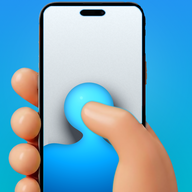
Scroll friction attaches resistance to the gesture itself. Each scroll becomes a drag through on screen fluid. Past a threshold you set, a bubble forms under your thumb and has to rise off the screen before the feed advances, so a short video feed moves roughly one item per deliberate drag. A fast flick bursts the bubble, and a burst advances nothing.
What that does is restore the missing decision point. Not by blocking you, and not by asking a question you can dismiss, but by making continuing cost enough to notice. People describe the result the same way: they can still scroll, they simply stop doing it by accident.
The limitation is real and worth stating. If you want to scroll and you are willing to work slightly harder for it, friction lets you. It converts unconscious scrolling into deliberate scrolling rather than eliminating it. For most people that removes the bulk of it, but it is a different promise from a wall. Friction versus blocking sets out the tradeoff properly.
The mechanics are in how scroll friction works, and the app is free on Google Play and on the App Store.
The evening version of the question
If your honest answer is "I can stop during the day and not at night", you are dealing with a different problem, and a stricter daytime rule will not fix it.
Self control is worse when you are tired, the room is dark, and there is nothing scheduled after. That is why a flat daily setting is wrong at both ends of the day, and why time based rules tend to outlast blanket ones. Why you scroll at night covers what actually helps there.
Why the usual advice never answers why can't I stop scrolling
Look at standard advice against this list.
Everything on that list intervenes before the session or around it. None of them touches the swipe. That is why sessions stay the same length even when people successfully reduce how often they open an app, which is the pattern described in how to stop doomscrolling.
| Common advice | Which mechanic it targets | Why it fades |
|---|---|---|
| Delete the app | All three, bluntly | You reinstall it within a week |
| Set a time limit | None directly | The limit fires once, you dismiss it |
| Greyscale your screen | Mechanic 1, weakly | You adapt to the colours within days |
| Turn off notifications | Entry, not duration | Helps you open it less, not scroll less |
| Just be more disciplined | Nothing | There is no decision point to be disciplined at |
Common questions
Is not being able to stop scrolling a willpower problem?
It is better understood as a design one. Feeds remove the natural stopping cues that end other activities, and the swipe is too cheap to register as a decision, so there is no moment at which willpower has anything to act on.
Why does scrolling feel worse at night?
Self control is lower when you are tired, the room is dark and nothing is scheduled afterwards, so the same feed meets far less resistance. This is why time based rules tend to work better than a single flat daily limit.
Does deleting the app work?
It works while the app is gone and usually ends in a reinstall within a week, because it removes the tool rather than the mechanic. It also takes away the parts you genuinely use, which is what makes the decision easy to reverse.
What actually reduces session length?
Something that changes the swipe rather than the entry. Time limits and pauses intervene once per session, so sessions stay the same length even when people open apps less often. Friction on the gesture is what shortens the session itself.
Can I still scroll with friction turned on?
Yes, deliberately. Friction makes continuing cost enough to notice rather than blocking you, so intentional use stays possible and absent minded use largely stops. If you want to be locked out entirely, a hard block is the honest choice instead.